Life is all about relationships. Just think about how your whole life would change if you took your relational skills to a whole new level!
Why do some people seem to have closer and more enduring friendships and marriages than others?
Why do they perform so well in the workplace and advance so quickly in their careers?
How do they maintain such a close and influential connection with their children and relatives?
Why do they seem to have less conflict, and when it does arise, why are they able to resolve it so quickly and completely?
Why are they so effective at helping others resolve conflict that their friends and coworkers call them peacemakers?
Well, it’s seldom because they’ve got a higher IQ than others. Studies have consistently shown that high intelligence quotients do not automatically translate into success at home or in the workplace.
There is another kind of smart, however, that correlates strongly with success in all aspects of life. It’s called “wisdom.”
Wisdom can be applied to all aspects of life, including money management, physical health, sexuality and politics. But the most important place to apply wisdom is in our personal, family and workplace relationships.
RW360 has developed a concept called Relational Wisdom®, or simply RW, that integrates key wisdom principles with the science of emotional intelligence. The skills of relational wisdom can improve every area of your life, whether at home, with friends or in the workplace.
Relational wisdom, in essence, is the ability to treat other people the way you would like them to treat you.
More specifically, relational wisdom may be defined as your ability to discern emotions, interests and abilities in yourself and others, to interpret this information in the light of your personal values, and to use these insights to manage your responses and relationships constructively.
As you learn these skills, you can experience stronger relationships and less conflict at home and in the workplace, as well as improved team-building and better job performance and career advancement.
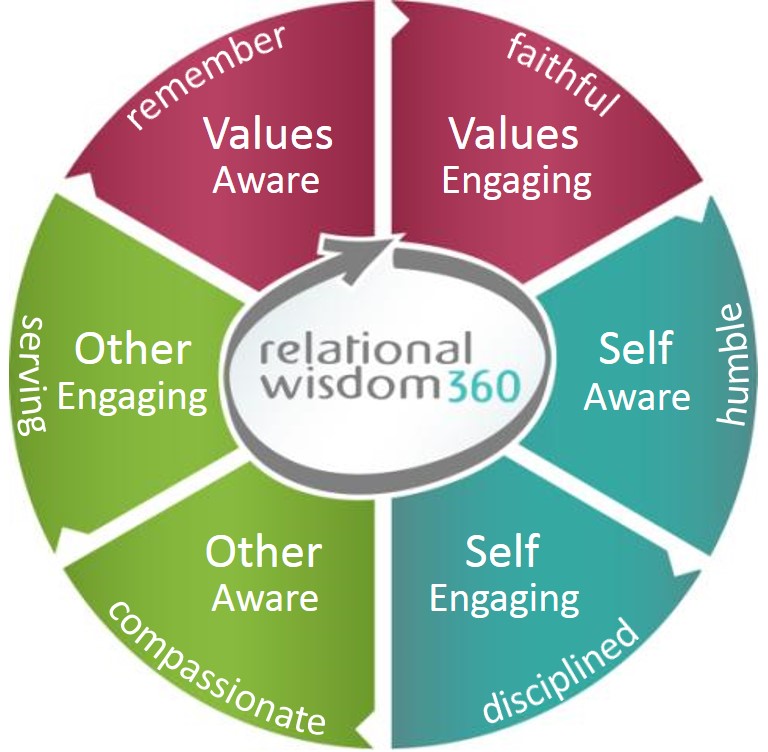
Relational wisdom involves six core skills that improve our ability to live out our values, to discipline ourselves and to serve others. Three of these skills involve “awareness” (what we see and understand), and three of them involve “engagement” (what we say and do). These skill may be defined as follows:
Values-awareness (remember) is the ability to honestly and accurately identify your true personal values.
Values-engagement (faithfulness) is the ability to consistently apply your values in real life.
Self-awareness (humility) is the ability to discern your own identity, emotions, thoughts, values, interests and abilities.
Self-engagement (discipline) is the ability to manage your thoughts, emotions, words and actions constructively.
Other-awareness (compassion) is the ability to understand and empathize with the experiences, emotions, values and interests of others.
Other-engagement (service) is the ability to love, encourage, serve and resolve differences with others in a mutually beneficial way.
Relational wisdom combines wisdom principles with scientific insights into the ways that our human neurology affects our emotions and impacts our relationships (see, for example Four Ways to Defeat Amygdala Hijacking).
The emotional and relational dynamics of human neurology are often referred to as “emotional intelligence” or “EI,” which may be defined as the ability to read and manage one’s own emotions as well as the emotions of others. Typical models of EI include four of the skills included in the relational wisdom paradigm: self-awareness, self-engagement, other-awareness and other-engagement.
Relational wisdom goes beyond typical emotional intelligence paradigms by adding two vital skills: values-awareness and values-engagement. This enhancement enables you to use your personal value system to guide the way you apply the skills of emotional intelligence.
This free ebooklet provides a detailed introduction to the relational wisdom paradigm, including its neurological insights and the ways that RW counteract some of the potential downsides of classic emotional intelligence.

Go deeper today by enrolling in our 8-hour course on relational wisdom, which includes detailed teaching and demonstration videos that show how you can develop enhanced relational skills that strengthen your friendships, marriage, parenting, job performance and career advancement.












Amygdala hijacking is a neurological process that damages many relationships. It involves three elements: a sudden unexpected emotion, that triggers an impulsive reaction, that is often immediately regretted. Relational wisdom can greatly reduce the frequency of these often harmful reactions (see 4 Ways to Defeat Amygdala Hijacking).
You can start digging deeper into this concept by reading our Introducing Relational Wisdom ebooklet. To go even deeper, register for our Exploring Relational Wisdom Course.